
Skip to the main content.

Product Spotlight

Development Solutions Page Hero-1

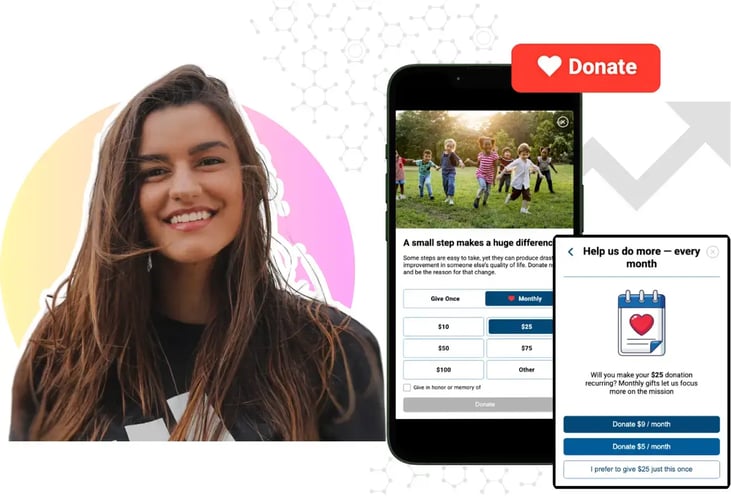
Mobile-First Pop-Up Donation Form

Launch mobile-first pop-up forms in minutes, use built-in tools to capture more donations, and optimize the giving experience—no dev team required.

The essentials

Donation page basics

New to online donation pages for your nonprofit? Start here.

Donation page A/B testing manual

Donation page A/B testing - no science degree needed.

Optimizing donation page load times

Keep your donation page loading fast - and drive higher conversions.

Recent

four-types-of-online-donation-experiences

The 4 Types of Online Donation Experiences

89% of donors leave without giving. Learn how to use the right donation form to close the gap and boost conversions.

4 min read

Finding Your Authentic Voice as a Social Impact Leader

Finding Your Authentic Voice as a Social Impact Leader

Why nonprofit leaders need to stop waiting for their work to speak for itself and start sharing their authentic voice.

Here's something I hear from nonprofit leaders all the time: "I just want the work to speak for itself." I understand the impulse. You're doing meaningful, mission-driven work. You're not interested in self-promotion, and I know you didn't get into this sector to build a personal brand — you got into it to create change.

But here's the reality: the work alone isn't enough. In a noisy, crowded landscape where donors, funders, board members, and partners are making decisions every single day, invisibility isn't humility. It's a liability. Sharing your authentic voice as a leader isn't about ego. It's about access: creating the conditions for the right people to find you, understand you, and trust you enough to say yes.

Finding Your Voice Is Only Half the Work

A lot of leaders spend time finding their voice: getting clear on their values, their mission, their "why." That's important work, but if your voice stays internal, it doesn't create impact. After working with 83 C-suite leaders over the last decade, I’ve seen time and time again that opportunities don't come from what you know. They come from what people can see and understand about you.

Think about the last time you trusted someone — a new board member, a consultant, a peer organization you decided to collaborate with. Chances are, you trusted them not just because of their credentials, but because you had a sense of how they think. You'd read something they wrote, heard them speak, seen them respond to a hard question. You had access to their perspective.

That's what sharing your voice creates: access. It lets the right donors, funders, collaborators, and advocates say, "I understand how this leader thinks, and I want to be part of what they're building."

Visibility Without Connection Is Just Noise

There's a difference between being visible and being connected, and in the nonprofit space, connection is what actually moves people to act. Connection happens when someone reads something you've written and thinks: "This person gets it. They're putting words to something I've been feeling." It happens when your perspective feels specific, honest, and real… not like a press release, not like a grant report, not like a carefully managed message.

So instead of asking "How do I sound credible?" try asking "Where can I be more honest here? More specific? More direct about what I actually believe?"

That might look like:

  • Sharing a moment that genuinely challenged your thinking about your organization's approach
  • Naming something that isn't working in your sector and why you care enough to say it
  • Being more direct about what you believe a better approach looks like

People don't connect with polish. They connect with perspective.

Scattered Messaging Is a Clarity Problem, Not a Content Problem

If you've ever felt like your messaging is scattered, like you're saying a lot but nothing is really landing, you're not alone. The problem usually isn't that you have too little to say; it's that you haven't gotten clear on three things:

  • What you actually believe (your core perspective on the work)
  • Who you're speaking to (your intended audience)
  • What you want to be known for (your leadership signature)

One of the most valuable exercises I walk leaders through is identifying a handful of core themes that anchor everything they communicate. These core themes are your guiding compass. You’ll find that this doesn’t limit your thinking, but instead, it focuses it. Because repetition builds recognition. In marketing, there's a well-known Rule of Seven that says people need to encounter a message at least seven times before it sticks. That number has grown significantly in recent years, with some experts now putting it between 14 and 20 touchpoints before a decision is made. Which means saying something once, even brilliantly, isn't enough. Clarity isn't about saying more. It's about saying the same meaningful things consistently enough that people remember you for them.

If It Feels Forced, It Probably Is

If your content feels forced, people can tell. If it's purely templated, if it sounds like it was written by committee, if it reads like everyone else's LinkedIn posts — it's not going to build trust. It's going to blend in. A lot of leaders fall into the trap of consuming content and thinking, "I should sound like this," or "This format performs well, so I'll copy it." But alignment (the feeling that your message actually reflects who you are) comes from starting with your actual thoughts. Not a trend or a template, and certainly not what you think a leader is supposed to say.

A simple shift: instead of asking "What should I post?" ask:

  • "What have I been thinking about lately that I haven't said out loud yet?"
  • "What do people ask me about most often?"

That's almost always where the most authentic content lives.

A Simple Place to Start

If you're not sure where to begin, start by identifying one "better way" belief. Think about your work and ask yourself: Is there something I see being done that I know isn't working? Is there an approach I believe would serve our mission and our community better? Let this be your foundation for building your visibility online. This will ensure everything you create will be tied to your unique experience and perspective. It’s what will separate you from every other thought leader out there.

For example, here is one of my “better way” beliefs that comes through in all the content I create: After years of watching small teams exhaust themselves trying to be everywhere online, I no longer believe that visibility should feel frantic. I believe the better way is intentional communication through fewer messages, deeper resonance, and a clearer sense of what you actually stand for.

This point of view is based on my lived experience, which means I can then share about it through a personal lens. I can share examples, stories, and proof to back up this belief in a way that makes people say “she gets it.”

The Reflection Worth Having

Before you think about your next post or your next email or your next donor communication, sit with these questions:

  • If someone spent five minutes looking at how I show up publicly, would they understand how I think?
  • Do the people I most want to reach — funders, partners, community members — have a clear sense of my perspective and my values?
  • Am I communicating consistently enough that I'm actually building recognition, or am I starting from scratch every time?

Your leadership voice is one of the most underutilized assets in the nonprofit sector, and yet most leaders haven't given themselves permission to say it clearly, consistently, and on their own terms. The work you're doing matters. Make sure the right people can see and understand the leader behind it.


About the Author

Brynne is a social media strategist for NGOs and purpose-driven businesses.

Working with NGOs, thought leaders, and policymakers in DC for the last decade, she specializes in getting people to care about complex issues that might otherwise get ignored.

Her team at Cause Fokus uses empathy-based marketing to turn passive audiences into loyal advocates.

The Creator Effect: How Influencers are Reshaping Giving

The Creator Effect: How Influencers are Reshaping Giving

During the Indianapolis leg of Taylor Swift’s Eras Tour, something unexpected happened on TikTok. Tess Bohne, a stay-at-home mom of three turned...
Read More
Strengthening Your Year-End Strategy Through LinkedIn

Strengthening Your Year-End Strategy Through LinkedIn

It’s 2025, and I think if we’re all being honest, year-end giving campaigns feel like they all blur together. Branded graphics. The same three...

Read More
How do I Begin Building Community at my Nonprofit?

How do I Begin Building Community at my Nonprofit?

There is a yearning. And post-COVID it feels like it is growing stronger.

Read More