
The Non-Profit Year-End Fundraising Planning Timeline
The Nonprofit Year-End Fundraising Planning Timeline It's that time again! Halloween costumes are on display in all the stores far too soon, but it’s...
Features
Product Spotlight

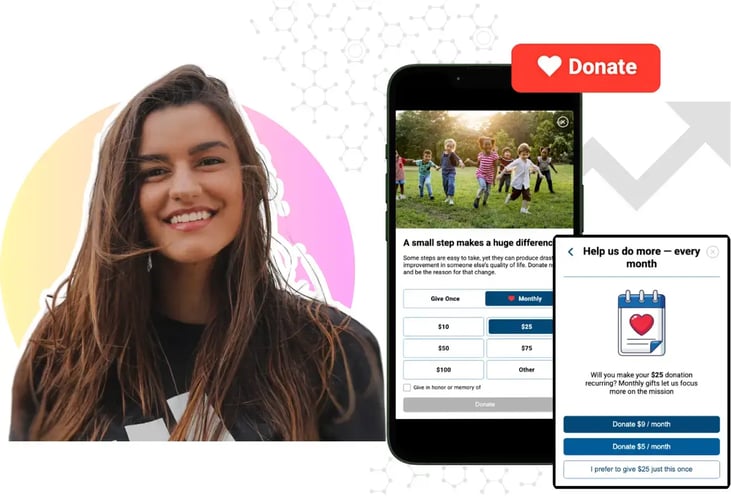
Mobile-First Pop-Up Donation Form
Launch mobile-first pop-up forms in minutes, use built-in tools to capture more donations, and optimize the giving experience—no dev team required.

By team
The essentials
New to online donation pages for your nonprofit? Start here.
Donation page A/B testing - no science degree needed.
Keep your donation page loading fast - and drive higher conversions.
Digital fundraising resources

The 4 Types of Online Donation Experiences
89% of donors leave without giving. Learn how to use the right donation form to close the gap and boost conversions.
4 min read
Brynne Krispin
:
Updated on October 5, 2026
By now, most nonprofit executives don't need convincing that LinkedIn matters. They already know it's the platform where millionaires and high-net-worth individuals are most active, and that four out of five LinkedIn members are decision-makers who influence where money goes.
They’re also seeing that journalist adoption of LinkedIn has climbed to 82%, recently overtaking X for the first time, according to Muck Rack's State of Journalism report, meaning reporters are increasingly using it to find sources and story leads, not just Google and press releases.
Just this week, a CEO of a tech safety nonprofit told me she had two national news outlets in her LinkedIn DMs asking to quote her in an upcoming article.
But seeing the value and feeling motivated to grow your presence on LinkedIn is the easy part. It's where almost every executive starts, and for a few weeks it goes well. Then reality sets in... Showing up consistently, with something worth saying, takes more time and thought than most already-stretched executives have to spare. So they do the next logical thing: they hand it to their comms team.
That's usually where the value slowly and quietly disappears.
A foundation program officer, a corporate partner, or a major donor doing diligence on your organization isn't just researching your programs. They're researching your leadership. And when they search your executive director's name and find a feed of polished, on-brand posts that could have come from anyone on staff, that gap between "active" and "credible" gets read as a signal, whether or not it's a fair one.
Your comms team should absolutely be part of this conversation. They understand your brand voice, your key messages, your audience, and how any single post fits into the broader strategy. That context is valuable, and cutting them out entirely would be a mistake.
But there's a different kind of work that happens when you're writing as a specific person instead of an organization, and it's easy to underestimate how much it actually takes. Capturing someone's voice isn't the same as knowing their bio. It means understanding how they actually think: the phrases they reach for without noticing, the point they always circle back to in conversation, the story they tell a certain way every time, the belief they'd defend even if it cost them a donor. It's the difference between writing about someone and writing as them.
When that layer is missing, even well-intentioned content starts to sound like it could have come from anyone on staff: polished, on-message, but forgettable. The words are technically fine, but the person disappears into them. That's the part most organizations don't notice is missing until someone points out that their executive director's posts read exactly like the company page.
The nonprofit leaders who get this right aren't the ones posting daily. They're the ones who've done the harder work first: getting clear on what they actually believe about their sector before they worry about what to say publicly. A simple four-stage model translates well here:
Focus: Before your executive director posts anything, they need one or two things they're actually known for: a strong point of view on donor trust, a hard-won lesson from a program pivot, a belief about the sector that isn't generic. Without this, everything they post will read as noise.
Visibility: Once that focus exists, consistency (even just once a week) beats frequency. A steady, specific presence outperforms a flurry of posts with no throughline.
Credibility: This is where funders and partners start connecting dots. They're not just seeing a post; they're seeing evidence that this leader knows the terrain and can be trusted to make good decisions with their money.
Trust: This is the payoff. The meeting that gets booked, the referral that comes in unprompted, the board member who feels more confident vouching for leadership externally because they've seen the thinking behind the decisions.
None of this works if it falls entirely on the executive's plate, and it shouldn't. The biggest reason executives stall out isn't time. It's the blank page. Sitting down to LinkedIn with no story queued up, no angle, no idea what to say this week, is enough to kill momentum before it starts.
That's where comms teams add real value. Instead of writing finished, brand-approved posts in the executive's name, the version of this that actually works looks more like a relay than a handoff:
Comms handles ideation, news sourcing, and a rough first draft, informed by the organization's overall strategy and what's happening in the sector that week.
The executive spends roughly one hour a week reviewing that draft and adding what I call their "signs of life": the specific story, the offhand comment, the detail that could only have come from them.
Comms takes it from there: scheduling, formatting, execution.
This turns the executive's job from "generate something out of nothing" into "react to something that's already most of the way there." That shift alone is often the difference between a presence that lasts and one that quietly dies after three posts.
If your comms team is already stretched thin, it might be worth bringing in outside help to get the system built. A LinkedIn strategist can come in, build out six months of ideas, first drafts, and a working calendar, set up the systems, and show your team how to use AI to move faster; then train your comms team to run it independently from there. With this route, the goal isn't dependency. It's a system your team can sustain long after the setup work is done.
Nonprofit comms teams don't need to disappear from this work, and executives don't need to carry it alone. The version that actually works splits the labor: comms brings structure, sourcing, and a first draft; the executive brings the hour a week of specificity that only they can provide. Skip either half, and the whole thing falls apart, either the executive burns out trying to do it all, or the comms team ends up quietly ghostwriting a mouthpiece.
If a funder, partner, or board prospect is Googling your executive director tonight, what they find should sound like a person, one supported by a team that knows how to help them sound like themself.
The Nonprofit Year-End Fundraising Planning Timeline It's that time again! Halloween costumes are on display in all the stores far too soon, but it’s...
If you work on a fundraising team at a food bank, you probably know the feeling. Your team is small, your budget is tight, and your donation page has...
Social service nonprofits are under pressure to do more with less, especially when fundraising tools don't talk to each other. Disconnected platforms...